How we work

The Five Stars Method

Five phases, matched to how a serious leader actually buys and de-risks a process transformation.

StructureFive phases, evidence before investment
ControlA governance checkpoint at every step
ProofMeasured against a real baseline
Why a method

A disciplined path from question to production value

Most process transformations stall because they skip the boring parts: no baseline, governance added late, integration never planned. The Five Stars Method sequences the work the way a serious leader actually buys and de-risks an initiative — so investment follows evidence and every phase leaves you with something decision-ready.

  1. UnderstandWe pinpoint the process that is slow, costly or hard to audit, and map how it really runs.
  2. PrioritizeWe rank opportunities by value, effort and risk, and pick the first process.
  3. PilotWe build a controlled solution with human review designed in.
  4. ProveWe measure against the baseline you agreed on.
  5. ScaleWe extend what works, harden governance, and hand it over.
The five phases

How the work moves, star by star

Each phase has a clear promise, a defined input and output, and a human checkpoint before you commit further.

  1. Understand

    Understand where AI can create real operational value.

    We identify which processes are too slow, too costly or impossible to audit, then map how the chosen one actually runs — people, documents, approvals, exceptions — quantify where time, accuracy, and visibility are being lost, and separate genuine opportunities from AI noise.

    Inputs
    Current process description, sample process steps, business pain points, constraints on data, approvals, and systems.
    Outputs
    A prioritized view of process friction and the three opportunities most worth evaluating first.
    Duration
    Typically a focused discovery session and follow-up summary.
    Your involvement
    The leader who owns the process, plus anyone close to the day-to-day work.
  2. Prioritize

    Turn opportunities into an ROI-ranked roadmap.

    We frame likely ROI, effort, and feasibility for each opportunity, then sequence them so the first build is both high-value and low-risk.

    Inputs
    Discovery findings, volume and cost data, and leadership priorities.
    Outputs
    A light ROI and effort estimate per opportunity and a recommended first pilot.
    Duration
    Days, not months.
    Your involvement
    Leadership alignment on where to start and what success looks like.
  3. Pilot

    Build a controlled pilot with human review in the loop.

    We build a working solution for the first process — AI-assisted extraction and processing with validation, low-confidence flagging, approvals, and audit history designed in.

    Inputs
    Real documents and process steps, access to relevant systems, and a named business owner.
    Outputs
    A working, controlled pilot that handles real work with human verification where it matters.
    Duration
    Usually weeks, scoped to a single process.
    Your involvement
    Regular review of extraction quality, exceptions, and process fit.
  4. Prove

    Show the value in numbers before anyone decides to scale.

    We compare the pilot against the pre-project baseline — cycle time, people involved, error and exception rates, and visibility — so the value is documented, not assumed.

    Inputs
    Baseline metrics captured up front and pilot performance data.
    Outputs
    A clear before-and-after picture and a decision-ready case for scaling.
    Duration
    Runs alongside the pilot.
    Your involvement
    Agreement on what "better" means and confirmation of the measured result.
  5. Scale

    Roll out with governance and integration for the long run.

    We extend the proven process to more vendors, locations, departments or regions, harden governance and access controls, and prepare structured data for ERP, SAP, and reporting integration.

    Inputs
    A proven pilot, rollout priorities, and integration requirements.
    Outputs
    A scalable, governed process and a foundation for broader operational AI.
    Duration
    Phased, aligned to operational risk tolerance.
    Your involvement
    Change management, ownership handover, and integration planning.
The heart of the method

What discovery actually looks like

Discovery is the heart of the method. It is where we earn the right to recommend anything — by understanding the process better than any document about it.

Shadowing a real process with the people who do the work
  1. 01

    Structured interviews

    With the process owner and the people who do the work — not just the org chart.

  2. 02

    Shadowing a real cycle

    We follow one real case end-to-end, including the workarounds nobody wrote down.

  3. 03

    As-is process map

    Every step, handoff, document, approval and exception, drawn so everyone agrees it is accurate.

  4. 04

    Baseline capture

    Cycle time, volume, people involved, error and exception rates — the numbers we will be measured against.

  5. 05

    Constraints

    Data, approvals, systems and the law that applies to you — known before anything is designed.

  6. 06

    Critical review of requirements

    What people ask for versus what the process actually needs. The two are rarely the same.

  7. 07

    Options with effort and benefit

    Three ranked opportunities, each with effort, benefit and risk spelled out.

  8. 08

    Recommendation

    One recommended first pilot, with scope and success criteria you can take to a decision.

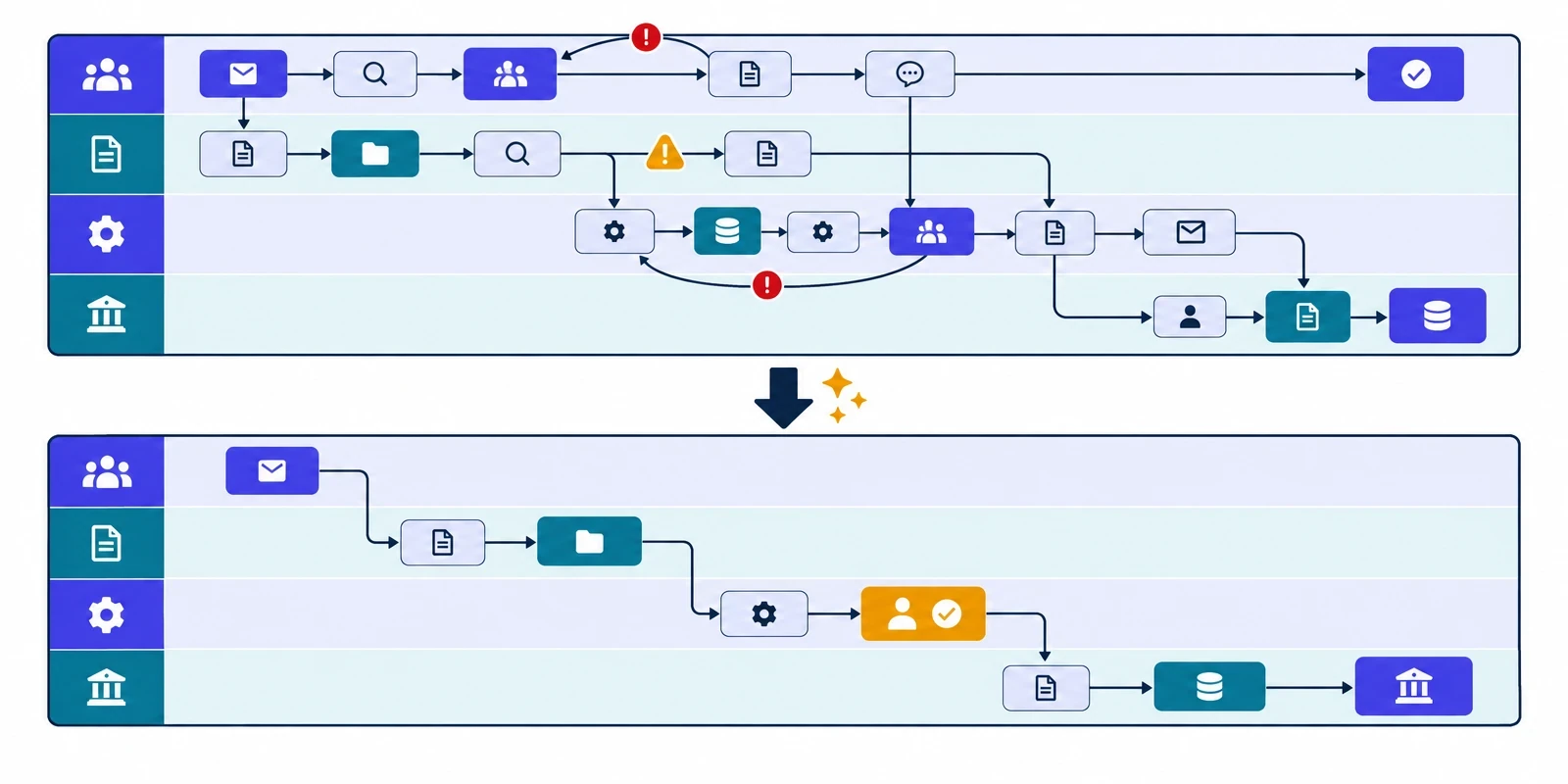
As-is process map with loops and handoffs above a simpler to-be process with a human checkpoint
As-is versus to-be: fewer handoffs, no rework loops, one human checkpoint where judgment matters.
Governance and proof

Control at every step, value measured against a baseline

Three safeguards are built into every engagement. They are what make the result something leadership can trust, sign off and defend — and they stay in place after we hand the process over.

At every phase

A human checkpoint

Before the project moves to the next phase, you review what was produced and decide whether to continue. Inside the finished process, the AI prepares each consequential decision and a named person approves it.

What this gives you: Nothing moves forward — in the project or in the process — without someone on your side saying yes.

Before we build anything

A measured baseline

During discovery we measure how the process performs today: cycle time, volume, people involved, errors and exceptions. We agree those numbers with you in writing.

What this gives you: The pilot is judged against your own numbers, not our estimates — so you decide whether to scale on evidence.

Across the whole process

A complete audit history

Every step is recorded: who reviewed, changed or approved what, when, and on which original document.

What this gives you: Any decision can be reconstructed later — for your auditors, regulators or leadership.

Common questions

How leaders pressure-test the method

Straight answers on commitment, timing, human review, ROI, and governance as you scale.

Do we have to commit to all five phases?

No. Most engagements start with Understand and Prioritize so investment follows evidence. You decide whether to move into a pilot once you can see the likely ROI.

How long until we see real value?

The goal is weeks, not quarters. A focused pilot targets a single high-value process so you get a measured result before committing to a broader rollout.

Where does human review fit?

Everywhere it matters. Extraction and processing are AI-assisted, but validation, low-confidence flagging, and approvals keep people in control of business-critical decisions.

How do you measure ROI?

We capture a baseline in the Understand phase — cycle time, people involved, error and exception rates, visibility — and measure the pilot against it in the Prove phase.

What happens to governance as we scale?

Governance is designed in from the pilot: role-based access, approvals, and audit history. Scaling hardens those controls rather than bolting them on later.

You can start at any phase, but most engagements begin with a focused discovery so investment follows evidence.

Have a process that is slow, expensive or hard to audit?

Tell us about it in 30 minutes. You will leave with three places to look and an honest view of whether AI belongs there.